How Often To Turn Compost In Winter: Best Proven Schedule For Effective Results
Opening a compost bin in January can feel like checking on a hibernating animal. The contents are cold, stiff, and nearly unchanged since December. Most gardeners instinctively reach for a fork and start turning, assuming the pile just needs a nudge. In practice, the opposite is usually true.
Winter composting runs by a different set of rules. The proven answer to how often to turn compost in winter is every three to four weeks — but only when the pile actually needs it. Turning a cold pile too often destroys the heat it has left, which is the one resource it cannot afford to lose. You can also read our guide on how long does it take for compost to decompose.
Why Winter Changes the Composting Rules
In summer, turning a pile every few days is a reliable way to add oxygen and restart heat. In winter, every turn becomes a heat-loss event. The microorganisms that drive decomposition slow down dramatically when soil temperatures drop, so their need for oxygen drops with them.
A pile that hits 55°C (131°F) in July may struggle to hold 15°C (59°F) in January. At near-freezing temperatures, even thermophilic bacteria become dormant. The pile does not stop working, but it operates at a crawl. Because the microbial population shrinks, the oxygen demand shrinks with it. That changes the entire job of winter aeration: rather than feeding oxygen to a hungry system, you are simply keeping air channels open so the low level of activity can continue. You can also read our guide on how long to compost vegetable waste.
A simple way to remember this is that kitchen peelings break down in weeks during summer but can take months during winter.
Heat Is More Valuable Than Airflow in Winter
An active compost core acts like a storage heater. The outer layers insulate it, and the inner heat keeps decomposition moving even when the outside temperature is freezing. Turning the pile thoroughly flips that warm core to the cold surface, and within an hour the pile can lose heat that took days to build. You can also read our guide on how often to feed small fish.
This is why experienced composters say that in winter, the best aeration is the aeration you don’t do. A common mistake is assuming that more turning equals faster breakdown. During winter, the opposite is often true.
The Proven Winter Turning Schedule
The chart below is a practical baseline based on typical outdoor winter conditions. Use it as a starting point, then let the pile’s temperature, moisture, and smell overrule the calendar. You can also read our guide on how often do you clean a betta fish tank.
| Condition | Recommended Interval | Why It Works |
|---|---|---|
| Air temperature below 0°C (32°F) | Every 4 weeks | Microbes are nearly dormant; turning mainly prevents compaction and ice layers. |
| Air temperature 0–7°C (32–45°F) | Every 3 weeks | Slightly more active; a light turn every three weeks keeps air flow steady. |
| Mild winter 7–15°C (45–59°F) | Every 2 weeks | Decomposition continues at a meaningful pace; more oxygen supports activity. |
| Pile completely frozen | Do not turn | Frozen material gains no aeration benefit, and turning damages its structure. |
For most gardens, every three to four weeks remains the strongest rule of thumb. If you keep a small pile, lean toward four weeks. If you have a large, well-insulated pile that still holds warmth, you can often leave it even longer.
Read the Pile, Not the Calendar: The Three-Check Method
Before every scheduled turn, spend two minutes checking three things. This condition-based approach matches the home-composting guidance from the U.S. EPA: balance moisture, oxygen, and carbon instead of forcing a routine. You can also read our guide on how long to compost chicken manure.
- Core temperature. Insert a compost thermometer into the center. Above 25°C (77°F) means the pile is still active, so turn it gently. If it matches the outside air temperature, turning won’t help — leave it covered.
- Moisture content. Squeeze a handful of material from the middle. It should feel like a wrung-out sponge. Too wet means add shredded cardboard; too dry means bury juicy scraps deeper. Frozen material cannot be fixed by turning.
- Odor profile. An earthy smell means the pile is balanced. A sour or ammonia smell means anaerobic pockets have formed, and that is the moment to turn despite the calendar.
Build a Pile That Needs Less Winter Turning
The easiest way to reduce winter turning is to build a pile that doesn’t need much of it. Size, carbon content, and cover make the biggest difference.
Size matters. A pile smaller than about one cubic yard (0.75 m³) will lose heat faster than it produces it. In winter, err on the side of bigger. A well-built pile holds warmth, and a warm pile lets you relax your turning schedule completely.
Browns are the real winter workhorses. Carbon-rich material such as shredded cardboard, dry leaves, straw, and wood chips creates air pockets that stay open even when the pile compresses under snow. Understanding how woody waste breaks down slowly also explains why those coarse pieces are worth keeping in the mix: they provide the passive airflow that makes frequent turning unnecessary.
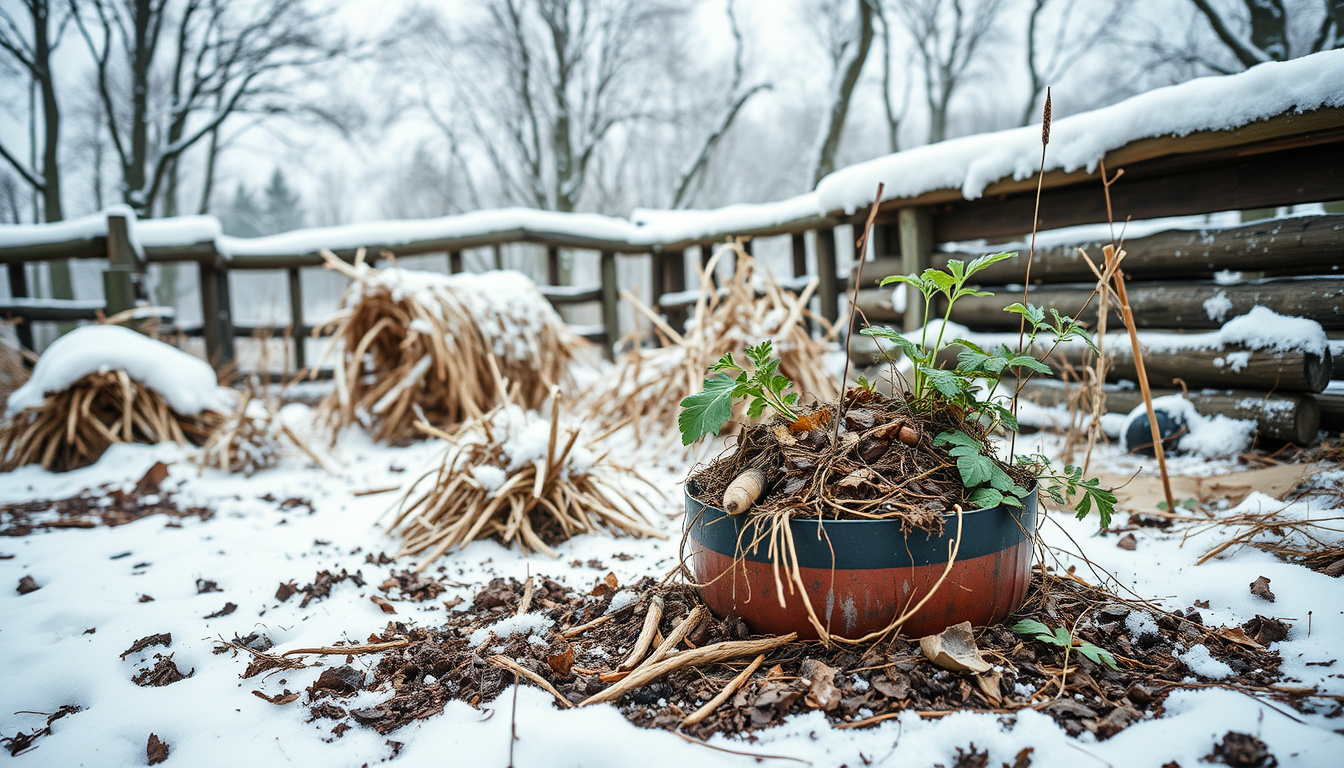
Cover the pile with a tarp, a thick layer of leaves, or a compost blanket. That simple layer keeps rain and snow out, reduces compaction, and traps whatever heat the pile manages to produce. A covered pile can easily go four weeks without turning. An exposed, waterlogged pile will need regular rescue.
How to Turn Compost in Winter Without Losing Heat
When a turn is genuinely needed, change your technique. This is not the full-inversion summer turn. It is a gentle lift-and-loosen job that takes under ten minutes.
The Minimal-Disturbance Technique
- Clear away any snow or crusted surface.
- Remove only the top 10–15 cm (4–6 inches) of material and set it aside on a tarp.
- Insert a garden fork into the upper half of the pile and lift gently, breaking up dense clumps without flipping the layers.
- Work around the edges and corners, where compaction is usually worst.
- Return the top layer and cover the pile immediately.

Loosening only the upper layers preserves the warm core while restoring air flow.
A full turn can expose the warm core to freezing air for twenty to thirty minutes. A minimal turn keeps it buried beneath an insulating blanket the entire time. You still restore airflow and moisture distribution, but you do not sacrifice the heat that keeps the pile alive.
Keep Adding Kitchen Scraps the Right Way
You can continue feeding the pile through winter, but the method changes. Chop scraps small and bury them at least 15 cm (6 inches) below the surface. Always add an equal or larger volume of browns.
This single habit prevents the soggy, anaerobic mess that forces emergency turning in January. When you bury rather than mix, the pile stays stratified: active breakdown happens in the middle, while the outer layer keeps doing its insulating job.
Should You Turn Compost or Leave It Alone?
A well-behaved winter pile is often a sign to do nothing. That feels counterintuitive after a summer of constant turning, but restraint is the highest skill in cold-weather composting.
Leave These Piles Alone
Piles that maintain a steady internal temperature, smell earthy, and are not compacted can stay untouched for a month or longer. A fully frozen pile is also a do-not-touch zone. Turning frozen material fills the structure with icy slush, and when it thaws, that slush compacts into a dense block that takes weeks to recover.
If the pile is frozen solid, simply wait for a thaw. There is no productive action to take.
Turn Immediately If You See These Warning Signs
Some conditions demand intervention even in deep winter.
- Strong ammonia smell means the pile is nitrogen-heavy. Mix in shredded paper, dry leaves, or cardboard.
- Sour, vinegar-like odors mean airflow has collapsed. A gentle turn with dry browns will help.
- Visible waterlogged layers need drier material mixed through the affected zone.
- Compacted edges should be loosened with a fork, especially near bin walls where dead zones form.
If only one corner has turned anaerobic, turn that section. Do not disturb the whole pile to fix a pocket.
Five Winter Composting Mistakes That Cost You Spring Compost
- Turning out of habit. Every unnecessary turn is a heat-loss event. In practice, a pile turned weekly in winter can take a full month longer to finish than an untouched, stable pile.
- Adding wet greens without browns. Summer grass and kitchen waste are nitrogen-heavy, and winter means less evaporation. Without browns, those greens become anaerobic pockets.
- Ignoring edge compaction. Probe around the bin walls, not just the middle. Dead zones hide in corners.
- Turning frozen material. It provides zero aeration benefit and destroys the ice structure that keeps air spaces open.
- Leaving the pile uncovered after turning. Removing the blanket is like opening the door of a wood stove. Insulation is the most effective winter tool you have.
If you use manure in your compost, remember that poultry litter composts best when paired with plenty of carbon. Adding high-nitrogen material in winter without browns is exactly how ammonia problems start.
Transitioning From Winter to Spring
The change of season does not mean flipping a switch. A pile that has been dormant all winter needs time to rebuild its microbial population.
Let the Pile Reheat Before Increasing Frequency
Watch for signs that the pile is waking up: core temperatures above 40°C (104°F) and steam rising on cold mornings. Only then should you move from every three to four weeks to every two weeks. Finally, as the weather stabilizes, return to a weekly rhythm.
Jumping straight back to weekly turning while the pile is still cold creates the same problem as turning it in January. The turning itself becomes a cooling event, and it delays the very activity you are trying to encourage.
Rebalance the Pile Before You Ramp Up
Snowmelt leaves many piles soggy and overly compacted. Before resuming a regular schedule, add dry browns and check the texture. A pile that went into winter heavy on green material will need more carbon. A pile that went in heavy on wood will stay slower and may need a few extra weeks before regular turning makes sense.
For gardens that rely on lawn waste, remember that grass clippings decompose quickly once heat returns. That is your signal to restart regular turning rather than a warning to avoid it.
Frequently Asked Questions
How often should you turn compost in winter?
Every three to four weeks is the right baseline for most cold-climate piles. Turn sooner only if the pile develops strong odors, becomes waterlogged, or shows clear signs of compaction. Condition-based decisions always beat strict calendar scheduling.
Should I turn compost when it is frozen solid?
No. Turning frozen material provides no aeration benefit and damages the physical structure of the pile. Wait until a thaw softens the material before attempting any intervention.
What is the ideal temperature for a winter compost pile?
Active composting happens between 40–60°C (104–140°F), but maintaining that range in winter requires a large, well-insulated pile. Many winter piles sit between 10–25°C (50–77°F), which is perfectly fine. Decomposition continues, just more slowly.
Can I keep adding kitchen scraps in winter?
Yes. Chop scraps small, bury them at least 15 cm deep, and add an equal or larger volume of browns. This keeps the pile from becoming a soggy, anaerobic mess.
How do I know if my compost needs turning?
Strong odors, soggy texture, and visible compaction indicate the pile needs attention. A pile that stays warm, smells earthy, and feels evenly damp can remain undisturbed for weeks.
Conclusion
Knowing how often to turn compost in winter comes down to respecting the biology of cold-weather decomposition. The every three to four week schedule gives you a solid foundation, but the pile itself is the real guide. Check its temperature, moisture, and odor before each turn, and resist the urge to apply summer techniques to winter problems.
A restrained approach that preserves heat and structure will produce better compost by spring than aggressive turning that cools the core and disrupts microbial communities. When you do turn, do it gently, re-cover immediately, and remember that insulation is your best winter tool.
By spring, that patience pays off with rich, dark compost ready to feed your garden. Once the pile is ready, the satisfying part begins — from working it into your beds to choosing planter colors that make your plants stand out.