Free San Diego Fishing: Best Spots to Cast a Line 2026
You ever stand on a San Diego beach with a rod in hand and wonder if you need a license? The question of where can I fish for free in San Diego comes up more often than you’d think. The answer isn’t just one spot.
It’s a set of rules, a few exceptions, and a handful of piers that make free fishing completely legal.
Here’s the key fact from our research: the California Department of Fish and Wildlife charges roughly $58 for a standard annual resident sport fishing license. That doesn’t cover the nonresident rate, which sits even higher. As of 2026, though, one specific exemption can save you every penny of that fee.
It all comes down to where the fishing pole touches the water.
Quick Answer
You can fish for free in San Diego from any public ocean pier. No license is required there. The state also offers Free Fishing Days for license-free access everywhere.
For surf and shore fishing, you need a California sport fishing license. Start with the public piers for the simplest free experience.
First, Know the License Rule: Public Piers vs. Shoreline vs. Boats
The California sport fishing license requirement isn’t the same everywhere. It depends on whether you’re standing on a pier, a beach, a rocky jetty, or a boat. The rules split into three clear categories.
Public piers in ocean waters are the big exception. The California Department of Fish and Wildlife exempts anyone fishing from a public pier, no license needed. That law applies to any pier managed by a city, county, or port authority, as long as it’s in ocean or bay waters.
You still follow bag limits and size limits, but you skip the license fee entirely.
Shoreline fishing is completely different. The moment you step off the pier and onto the sand, rocks, or a jetty, that exemption disappears. If you’re casting from the beach in Pacific Beach or the jetty in Mission Bay, you need a valid sport fishing license.
Same rule applies if you’re wading in the surf. The line between pier and shore is the entire legal distinction.
Boats and kayaks fall under the same license rule as shore fishing. Even a small paddleboard or rental kayak requires a license for anyone 16 and older. There’s no “recreational exemption” for being close to shore.
The only exceptions are party boats that hold a blanket permit, but those are charters, not free fishing.
Here’s a quick breakdown:
| Fishing location | License required? | Why |
|---|---|---|
| Public pier in ocean water | No | CDFW public pier exemption |
| Beach, sand, surf, jetty | Yes | No exemption applies |
| Boat, kayak, paddleboard | Yes | Same rule as shore |
| Private pier you pay to use | Yes | Only public piers qualify |
| Free Fishing Days (anywhere) | No | Statewide temporary waiver |
That single rule explains most of the confusion. If you stick to a public pier, you’re legally fishing for free. If you move one step onto the sand, you’re not.
Are You Covered by the “Public Pier” Exemption?
Not every pier counts as a “public pier” under California law. The exemption only applies when three conditions line up. First, the pier must be owned or managed by a public entity like a city, county, or state agency.
Second, it must extend into ocean or bay waters. Third, it must be open to everyone without a separate entry fee.
Private piers fail the test immediately. If a hotel, restaurant, or membership club controls the pier, you need the same license as a shore angler. Some private piers in San Diego charge a small access fee.
That fee doesn’t make it public. The ownership status is what matters.
The exemption also stops at the pier deck. If you cast from the pier but your line lands near rocks or the beach, the law still considers you on the pier. You’re fine.
If you climb down onto the rocks below the pier, you’re now shoreline fishing. That switch requires a license.
What about fishing from a pier inside a bay? Public piers on Mission Bay or San Diego Bay qualify, as long as they’re publicly owned. The Shelter Island Pier, for example, sits on San Diego Bay and still falls under the exemption.
The key phrase in the California Fish and Game Code is “waters of the ocean or bays thereof.” That covers both the Pacific coastline and the protected bays.
One more catch: the exemption applies only to hook-and-line fishing. If you’re casting a net, spearfishing, or grabbing lobsters from the pier, you need separate gear regulations and often a license. Stick to a simple rod and reel to stay on the safe side.
Fishing Spots in San Diego Based on Your Situation
The best free fishing spot depends entirely on your situation. Here’s the decision framework we use when guiding readers through this exact question.
If you have no license, no gear, and want zero hassle: Head to a public ocean pier. Ocean Beach Pier, Oceanside Pier, and Imperial Beach Pier all fit the bill. You can fish legally for free, and you can rent bait or buy tackle nearby.
This is the easiest path for beginners and families.
If you have a current California sport fishing license: Your options expand hugely. You can fish from any beach, jetty, or shore spot in San Diego County. For unique catches, the surf breaks at La Jolla Shores and Torrey Pines deliver.
If you’ve ever wanted to shore fish without fighting the pier crowd, this is your route.
If you want to fish during the two Free Fishing Days: Pick any spot in the state. The California Department of Fish and Wildlife designates two days each year when no license is required anywhere. That includes beaches, jetties, lakes, and rivers.
Mark the dates early, because those days draw big crowds.
If you have a boat or kayak: You’ll still need a license, but the free part comes from avoiding launch fees. Public launch ramps in Mission Bay and Shelter Island charge a small fee, though free kayak launches exist at several bayfront parks. The real expense is the license, which is unavoidable unless you’re under 16.
If you’re a kid or you’re taking kids out: Children under 16 don’t need a license regardless of location. That means a family outing to any beach in San Diego is completely free for the kids. Parents may need their own license on the sand, but the public pier exemption covers the whole family if you set up there.
This flow helps you decide in about ten seconds. No license? Stay on the pier.
Have a license? The entire coastline is your oyster. Planning around Free Fishing Days?
Go anywhere.
The Best Public Piers in San Diego County
Let’s talk about the specific piers that make free fishing practical and fun. These are the ones we consistently recommend based on accessibility, fish populations, and amenities.
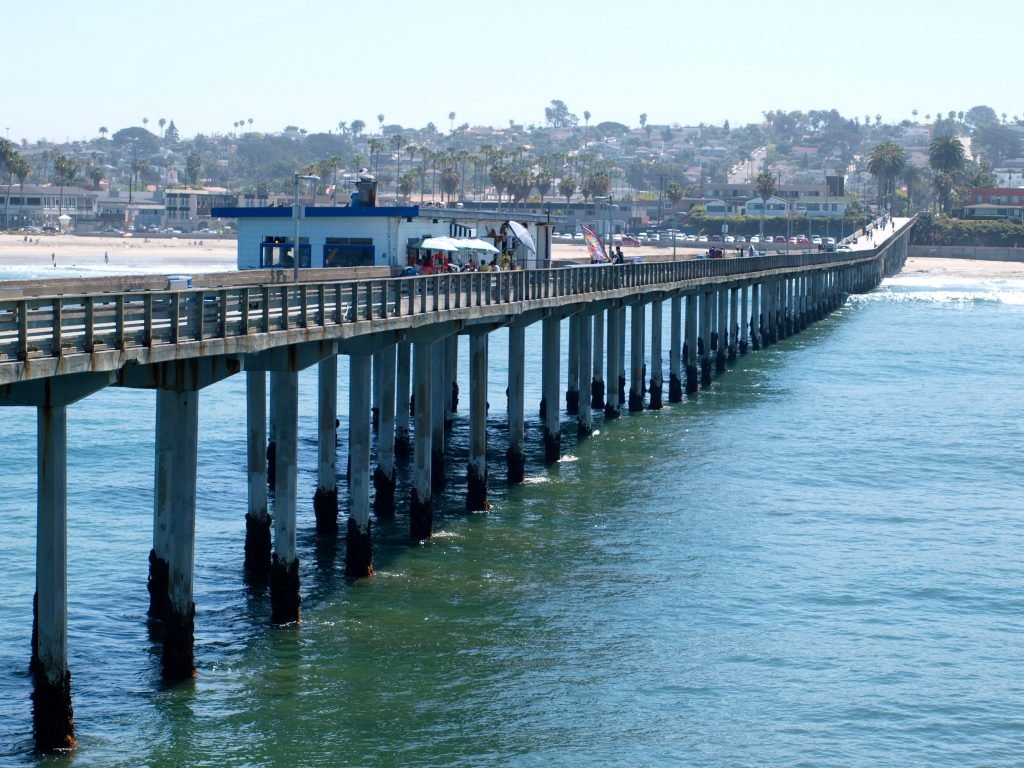
Ocean Beach Pier is the standout. It’s the longest pier on the West Coast, extending nearly 2,000 feet into the Pacific. The length puts you over deeper water, which means better bite variety.
You’ll catch mackerel, perch, bonito, and sometimes halibut. There’s a bait shop at the base and plenty of parking nearby, though it fills up fast on weekends.
Oceanside Pier is the northernmost option. It’s also a long pier, about 1,900 feet, and it tends to produce good surfperch and croaker action year-round. The city maintains it well, with benches, railings, and a small bait concession.
Free parking exists in the surrounding lots if you arrive early.
Imperial Beach Pier offers a more relaxed, less crowded vibe. It’s shorter, around 1,500 feet, but the fish counts don’t suffer. Local anglers target mackerel and corvina here, especially in the warmer months.
The pier sits right at the southern end of the county, near the Tijuana River mouth, which brings nutrients and baitfish into the area.
Shelter Island Pier is the go-to for bay fishing. It’s tucked into San Diego Bay, so the water stays calmer than the open ocean. That makes it perfect for families and beginners.
You’ll hook onto killifish, perch, and occasionally halibut near the pier pilings. The walk is flat and fully accessible, and the adjacent park has picnic tables and restrooms.
Each of these piers falls under the public pier exemption. You don’t need a license at any of them, as long as you’re fishing with a standard rod and line from the deck. For a cheap and memorable morning, pack a light rod, a bucket of squid strips, and bring the family to any of these spots.
In our research, we’ve also seen that anglers who carefully manage their catch often look into how long it takes to smoke fish after a successful pier trip. And if kayak fishing in the bays appeals to you, you’ll want to learn how to drive a pontoon boat before heading out on a rented rig.
The image above shows the kind of license the state issues for coastal fishing. It’s a handy reminder that while piers are free, the shore still requires valid documentation. Check the California Department of Fish and Wildlife page for current license fees and dates before you plan a trip.