How to Reupholster Boat Seats for a Clean, Durable Finish
Boat seats take more abuse than most car interiors: baking sun, salt spray, trapped moisture, and constant weight. That is why vinyl cracks, seams split, and foam collapses. A shop quote can be painful, but a weekend DIY job with marine-grade materials can give you the same clean look for a fraction of the price.
This guide shows you how to reupholster boat seats for a clean, durable finish, step by step. You will learn how to choose materials, remove the old cover, repair the base, stretch new vinyl without wrinkles, and reinstall the seat so water stays out. You will also learn the common mistakes that cause early failure and when it makes sense to hire a professional. For more on this, see our guide on how to clean boat seats.
Why Reupholster Instead of Replace or Hire Out
Replacement seats are expensive, and aftermarket bases rarely line up with the factory mounting holes. Reupholstering preserves the original mounting points and lets you keep the hinges, sliders, and hardware that already fit your boat.
Doing it yourself also gives you control over materials and color. You can upgrade to heavier, UV-stabilized marine vinyl, add firmer foam, and match trim exactly. The tradeoff is time and patience: the first cushion will take the longest, and complicated factory stitching is genuinely hard to duplicate at home. For more on this, see our guide on how to clean a boat.
| Option | Best for | Main downside |
|---|---|---|
| DIY reupholstery | Solid base, simple staple-on covers | Time, learning curve |
| Professional reupholstery | Piping, pleats, custom embroidery | Labor cost |
| New replacement seats | Matching store-bought style | Price, mounting compatibility |
If the rest of the boat is solid, reupholstering is the smart play. If the deck, transom, and engine are beyond saving, retiring an old boat may make more sense than investing in new vinyl.
Materials That Hold Up on the Water
The biggest reason boat seat upholstery fails early is using indoor furniture materials. Marine environments are different: UV rays break down plasticizers, salt attacks thread, and trapped moisture grows mildew. Choose every material with those three threats in mind. For more on this, see our guide on how to clean boat carpet.
Marine Vinyl
Use marine-grade or outdoor vinyl, not general-purpose upholstery vinyl. Marine vinyl is built with UV inhibitors and mildew resistance, and it often has a scrim backing that makes it more stable when you pull and staple.
When shopping, ask about the cold-crack rating. If you boat in a northern climate, vinyl that gets stiff in cold weather can crack the first time someone sits on it in early spring. Choose a product rated for the temperatures you actually see. For more on this, see our guide on best pontoon boat for the money.
Foam and Wrap
Standard open-cell foam acts like a sponge. Marine foam is formulated to drain and dry, and it holds up better under constant moisture. High-density foam supports weight without flattening out, which keeps the vinyl smooth.
A thin Dacron wrap around the foam is worth the extra step. It softens the hard edges of the foam, fills minor imperfections, and stops the foam texture from telegraphing through the vinyl. For more on this, see our guide on how to get rid of an old boat.
Thread and Fasteners
If you are sewing panels, use UV-resistant polyester thread rated for marine use. Cotton or ordinary nylon can rot or weaken in sunlight.
For staples, stainless steel is non-negotiable. Regular galvanized staples will rust, bleed through the vinyl, and eventually let the cover pull loose. Use 316 stainless staples when you can get them.
Material Cheat Sheet
| Material | What to choose | Why it matters |
|---|---|---|
| Vinyl | Marine-grade, UV-stabilized | Resists fading and cracking |
| Foam | High-density, quick-dry | Drains water, holds shape |
| Wrap | Dacron or polyester batting | Softens edges, smooths surface |
| Thread | UV-resistant polyester | Long-lasting seams |
| Staples | 316 stainless steel | Won't rust or stain vinyl |
| Adhesive | Marine-rated, low-VOC | Bonds foam, fewer fumes |
The same care you give to routine boat washdowns should also apply to the upholstery. Dirt and salt that sit on vinyl work their way into seams, so clean the seats when you clean the hull.
Tools and Workspace Preparation
You do not need a professional shop, but you do need a clean, dry, well-lit area. A solid workbench is important because staple lines and tension look different at eye level than they do on a boat.
Tool List
- Staple gun: pneumatic or manual; pneumatic is more consistent
- 1/4-inch crown 316 stainless staples, 5/16- to 3/8-inch leg
- Staple remover, flat pry bar, needle-nose pliers
- Sharp utility knife, scissors, straightedge
- Heat gun or heavy-duty hair dryer
- Electric carving knife for shaping foam
- Marine-rated contact adhesive
- Grease pencil or marker for pattern marks
- Dust cover cloth and optional foam wrap
- PPE: gloves, eye protection, respirator for adhesive fumes
Solvent-based contact adhesives release strong fumes and are flammable. If you use them indoors, follow respiratory protection guidance from OSHA, and keep the space ventilated. You can also compare the EPA's guidance on safer adhesives; many low-VOC water-based marine adhesives now work just as well with far less odor.
Try to work indoors or under cover. Direct sun softens vinyl and makes tension deceptive, while a damp garage can cause wood bases to swell. The goal is a controlled environment where the vinyl stays at room temperature until you are ready to use the heat gun.

A clean, well-lit workbench makes staple lines and vinyl tension easier to control.
Step 1: Remove the Seat and Strip the Old Cover
Start by removing the seat from the boat and keeping the hardware organized. Bag hinge screws, sliders, and spacers separately, and label each cushion so it returns to the same spot.
Take photos before unbolting anything. Hinge positions and seat slider mounts are easy to mix up, especially on a multi-seat boat. If the seat has wiring for heat or lights, disconnect it and tape the wires.
Work on the underside and remove staples in sections. Pull each staple out fully, then move to the next section. This keeps the cover intact enough to use as a pattern. Resist the urge to rip the vinyl off quickly. Torn seam allowances make accurate pattern tracing almost impossible.
If the old cover comes off in one piece, keep it. Even with cuts and cracks, it shows the original shape, seam placement, and grain direction. If it is too distorted, make a pattern by draping paper or plastic over the foam and marking the edges.
While the seats are out, it is a good time to tackle soiled deck carpet or refresh the interior. That way the reupholstered seat goes back into a clean space.
Step 2: Repair the Base and Rebuild the Foam
Now you can see the actual structure. Check the base for rot, flexing, water stains, and stripped screw holes. A little surface wear is fine; a soft or delaminated base is not.
If the base is plywood and the edges are soft, seal them with marine epoxy before reassembly. Fill stripped screw holes with epoxy or hardwood dowels, let them cure, then re-drill. If the base is beyond repair, replace it with marine plywood or a plastic composite such as StarBoard. Cut the new base to match the old one exactly.
The foam needs the same honest inspection. Press down on it and see whether it returns to shape. If it stays compressed, crumbles, smells musty, or has water stains, replace it. Use high-density marine foam, cut it slightly larger than the base, and bevel the top edges with an electric carving knife. A beveled edge prevents that hard, boxy look and reduces vinyl wrinkles.
Wrap the foam in Dacron and use a light coat of marine adhesive to hold it in place. Do not glue the foam down so aggressively that it blocks drainage. If the seat has weep holes, keep them open.
A common mistake is skipping the foam replacement because it looks fine on the outside. Old foam collapses unevenly, and a new cover stretched over it will look baggy within a month.
Step 3: Pattern, Cut, and Dry-Fit the Vinyl
This is the step that separates a clean finish from a puckered one. The vinyl has to be cut with enough allowance to wrap around the foam and staple to the underside of the base.
Lay the old cover flat on the new vinyl. Smooth out wrinkles, weight the pattern down, and trace around it with a grease pencil. Transfer every important mark: centerline, front and back orientation, and seam notches.
If you are working without an old cover, drape the vinyl over the foam and mark the centerlines directly on the backside. Always cut on the backside so the visible face stays clean.
Cut with a sharp blade and a straightedge. Dull blades drag and tear vinyl. Leave a generous allowance of at least 2 to 3 inches beyond the staple line. On large cushions, 3 to 4 inches is safer. You can always trim extra vinyl, but you cannot add it back.
Test-fit the cut vinyl over the foam before stapling. Check that the grain direction is consistent across the seat, and make relief cuts only at concave curves. A relief notch should stop well short of the visible edge and never cut into the face of the cover.

Saving the old cover as a pattern is the most reliable way to match a curved cushion.
Step 4: Stretch and Staple the Vinyl Without Wrinkles
Stapling looks simple, but the sequence matters. If you staple one side completely before starting the others, you pull the vinyl off-grain and create diagonal wrinkles.
Start with one staple at the center front and one at the center back. Then add one staple at the center of each side. From those four anchors, work outward in small steps, alternating sides. Pull the vinyl firmly toward the underside of the base before each staple so tension stays even.
Use a heat gun on low before sharp curves. Heat makes vinyl more pliable, but it can melt or shrink the surface if you hold it in one spot. Keep the gun moving and stop as soon as the vinyl feels warm to the touch. Professionals use the same technique to relax vinyl around tight corners.
For a corner, try a hospital fold. Pull the vinyl straight down over the corner, make one clean fold toward the center underside, and staple the fold down with two staples. The bulk stays hidden underneath, and the visible face stays smooth.
A common mistake is overstretching the vinyl until it is drum-tight. Vinyl relaxes in the sun, and an overstretched cover can tear at the staples or pull back from the edge. Use moderate, even tension, not maximum force.
If the base is wood or plywood, stainless staples will grip well. If the base is aluminum or plastic, staples may not hold. Use short stainless screws or rivets instead, and test the underside before committing.
Once the tension looks right, trim the excess vinyl with a sharp knife. Install a dust cover over the bottom if the original seat had one. This keeps moisture and debris out while allowing the foam to breathe.
Step 5: Reinstall the Seat and Seal It Against Moisture
The reinstall step is where many DIY seats start leaking from the inside. Every bolt hole and hinge mount is a potential water path into foam and wood.
Before fastening anything, dry-fit the seat and confirm the holes line up. Make sure no vinyl is pinched between the base and the mounting flange. Use stainless steel fasteners and apply a small ring of marine sealant around each bolt hole before threading the bolt down. Tighten hardware snug, not crushing tight.
If the original seat had drainage holes or a moisture barrier, replace it the same way. A plastic barrier helps only if the seat still has a path for air to move. If you trap moisture against the foam, you can create mildew problems.
After reinstalling, clean the vinyl with a mild soap-and-water solution and apply a marine UV protectant. Let it dry before anyone sits on the seat.
Then take the boat for a short test run. Listen for squeaks, check that the seats are level, and watch for vinyl that looks loose after sitting in the sun. This is also a good time to review boat handling basics, especially if this is your first outing of the season.
Common Mistakes That Shorten the Life of a Reupholstered Seat
- Stapling one full side before anchoring the other sides, causing wrinkles.
- Using non-stainless staples that rust and stain vinyl.
- Skipping base repairs and sealing, so wood rot continues under new upholstery.
- Reusing collapsed foam because it looks fine.
- Cutting the vinyl with no allowance, leaving nothing to pull and staple.
- Overworking the heat gun and burning the vinyl.
- Forgetting to seal bolt holes during reinstallation.
If you catch a problem after the first outing, fix it early. A loose corner is a five-minute job. Ignoring it can turn into a full panel redo.
DIY vs. Hiring a Professional: An Honest Take
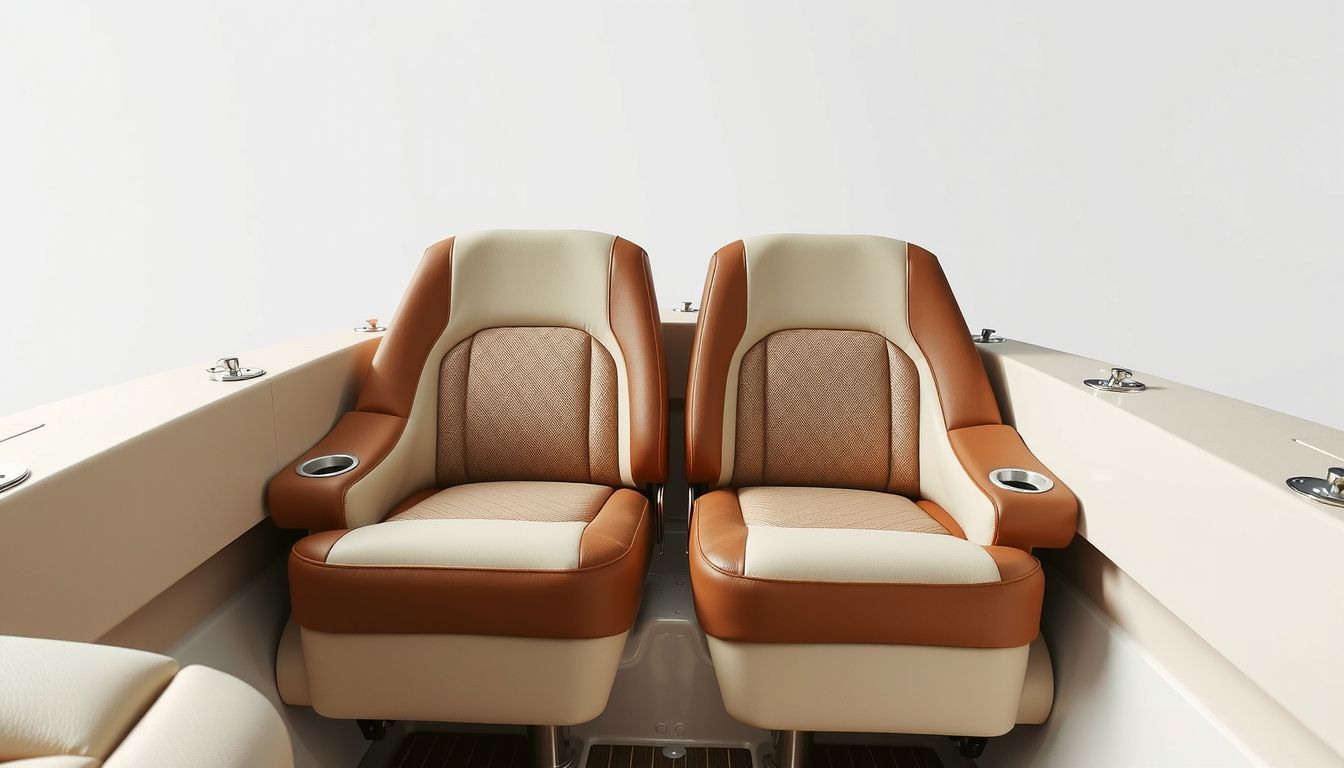
Reupholstering boat seats is not difficult in principle, but the difficulty varies with the seat design. A simple cushion with straight edges and a staple-on cover is a perfect DIY job. A captain's chair with pleated inserts, contrasting piping, and curved bolsters is much harder.
Call in a professional when the cover requires heavy sewing, embroidery, or seam patterns you cannot reproduce at home. Also call a pro if you are replacing a full boat's worth of seats and want a consistent factory look without trial and error.
That said, many boat owners recover the easy seats themselves and send one complicated seat to a shop. That balance keeps costs down without sacrificing the hard-to-master details.
If you are shopping for a boat with tired upholstery, factor that into the price. When sizing up a pontoon or any used boat, inspecting the seats before you buy gives you leverage and saves you from surprise expenses.
If the boat is an older aluminum model, new upholstery will make faded paint look older by comparison. Pairing the seat project with refinishing the hull can make the whole boat feel cared for.
Conclusion
Reupholstering boat seats is one of the most satisfying upgrades you can make. The process is straightforward: remove the seat, repair the base, replace the foam, cut new vinyl, staple it evenly, and reinstall with sealed hardware. The keys to a durable finish are marine-grade materials, stainless staples, and disciplined tension.
Start with one small cushion. Finish it, inspect it, and see how it changes the look of the cockpit. Once that first seat comes out clean, you will have the confidence and the process to work through the rest of the boat. New vinyl, solid foam, and dry hardware will make every seat feel as good as it looks.
Frequently Asked Questions
How long does it take to reupholster a boat seat?
Plan on 2 to 4 hours for a basic bucket or bolster cushion. A long bench or sun pad with new foam can take a full day. The first seat is always the slowest because you are learning the sequence; later cushions go much faster.
Can I reupholster boat seats without sewing?
Yes, if the cover is a one-piece wrap that staples to the underside of the base. Many boat seats are built this way, so you can cut the new cover and staple it without sewing. Multi-panel seats with piping or pleats usually need a sewing machine or a professional.
What kind of vinyl is best for boat seats?
Use marine-grade vinyl with UV inhibitors, mildew resistance, and a scrim backing. It is heavier and more stable than indoor vinyl, and it is designed to handle sun, salt, and temperature swings. Ask the supplier for a cold-crack rating that matches your boating climate.
What kind of foam should I use?
Choose high-density, quick-dry marine foam rather than standard upholstery foam. Marine foam resists water absorption and mildew, which keeps the seat from breaking down from the inside. Wrapping the foam in Dacron also smooths the surface and prevents vinyl wrinkles.
Why do my boat seats keep rusting around the staples?
Most likely the staples are not stainless steel. Galvanized or ordinary steel staples rust in marine air, and the staining spreads into the vinyl. Use 316 stainless steel staples and make sure the base is dry before you staple. Sealing the wood base also reduces moisture behind the cover.
Is it cheaper to reupholster or replace boat seats?
Reupholstering is almost always cheaper because you keep the existing base, hardware, and sometimes foam. Replacement seats cost more and may not match the factory mounting pattern. DIY reupholstery is the least expensive route; professional upholstery still usually beats full replacement for older boats.