What Age Can You Drive A Boat By Yourself: State Rules
Few questions create more confusion at the launch ramp than this one: what age can you drive a boat by yourself? It sounds like a simple yes-or-no answer, but the truth is that minimum ages shift dramatically depending on where you're boating, what type of vessel you're operating, and whether you've completed a state-approved education course.
A 14-year-old could legally operate a small outboard skiff alone on one lake, then cross a state line and face a minimum age of 16 with adult supervision required. Add personal watercraft restrictions, horsepower caps, and county-level ordinances, and the rules become genuinely complex. You can also read our guide on how to learn how to drive a boat.
This guide breaks down the age thresholds, education requirements, local variations, and practical enforcement realities you need to understand before handing the helm to a young operator. We'll also cover how to verify the exact rules for your specific waterway—because guessing isn't an option when legal liability and safety are on the line.
Understanding What "Driving By Yourself" Actually Means
Before examining state-specific rules, it's important to clarify what "by yourself" means in a legal and enforcement context. The critical term in most boating statutes is operator—the person physically controlling the vessel's speed, direction, and navigational decisions at any given moment. You can also read our guide on how do you start a boat after winterizing.
The operator is not always the owner. A teenager can legally operate a family boat while a parent holds the title and registration. Marine patrol officers focus on who is actually at the helm, not whose name appears on the paperwork. This distinction matters for both enforcement and liability.
"By yourself" typically means unsupervised operation: no qualified adult on board who can take immediate control. Many states permit younger operators when a responsible adult is present and capable of intervening—even if that adult isn't touching the steering wheel. Sitting in the bow seat while a teen drives? That counts as supervision in most jurisdictions. Sitting on the dock watching from shore? That does not. You can also read our guide on how to drive a pontoon boat.
Consider this scenario: a 14-year-old steering a 16-foot bowrider on a calm lake with a parent seated in the passenger console is generally considered supervised operation. If that same teen takes the boat out with only friends aboard, it becomes unsupervised operation, which triggers age minimums and certification requirements that may not have applied with an adult present.
Key terms to understand:
- Operator — Controls the boat and bears legal responsibility for safe navigation
- Owner — Holds title or registration and may share liability even when not operating
- Qualified supervision — A legally eligible adult on board who can immediately take the helm
- Passenger-only adult — May not count as supervision if impaired, asleep, or not legally qualified themselves
If you're new to boat handling entirely, reviewing the fundamentals of driving a pontoon boat before teaching someone else is a smart starting point.
Why Age Rules Vary by State and Waterway
Minimum age rules don't align nationwide because recreational boating is regulated through a patchwork of state statutes, county ordinances, municipal codes, and federal navigation rules. The answer to what age can you drive a boat by yourself can legitimately change after crossing a county line or launching on a different reservoir ten miles down the road.
States establish their own thresholds based on local accident data, boating density, enforcement capacity, and legislative history. Some focus on age alone. Others tie solo eligibility directly to a state-approved boater education course, treating the certificate as the real gatekeeper rather than a birthday.
Waterway type adds another layer. A quiet inland lake may be governed primarily by state law, while coastal waters, major rivers with commercial traffic, and federally managed reservoirs can involve additional requirements around navigation, equipment, and operator qualifications.
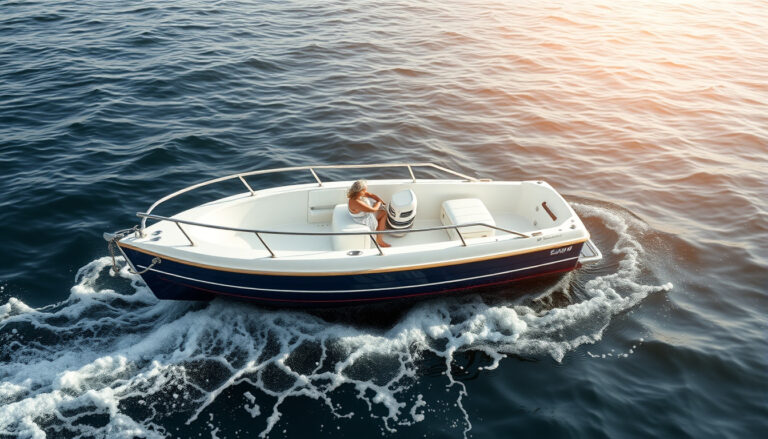
 State and local rules determine whether this young operator can legally run the boat without adult supervision, even on a calm lake.
What shapes the rules in practice:
- State statutes — Define baseline age limits, education mandates, and supervision standards
- Local ordinances — Add speed zones, curfews, or special restrictions for specific lakes and reservoirs
- Vessel type and horsepower — PWCs and high-powered outboards almost always face tighter minimums
- Enforcement reality — Rules are written to match local patrol resources and known risk patterns
A 15-year-old who can operate unsupervised on a state-managed reservoir after passing a boater card test might still face restrictions on a nearby river with heavy barge traffic and stricter local oversight. The waterbody matters as much as the state line.
Boater Education Cards: The Real Gatekeeper
In many states, the practical eligibility question has shifted from "how old are you" to "have you completed a boater education course?" A boater education card—sometimes called a safety certificate or boating license—often serves as the key that unlocks solo operation for younger boaters.
The common pattern: a younger operator may run a motorboat or PWC only after completing an approved course and carrying proof of completion on the water. Some jurisdictions treat the card as a permit substitute. Others still impose strict minimum ages regardless of training, meaning a certificate helps but doesn't override the age floor.
Courses typically cover the causes of most recreational boating incidents—speed, alcohol impairment, lookout failures, and navigation rule violations—then test for retention. Look for state-approved options that align with NASBLA standards, the national framework most states use for course content and reciprocity. Confirm whether your course applies to the specific waterway, because state lakes and federal waters can have different acceptance rules.
How a boater card changes eligibility:
- Eligibility boost — Completion may allow independent operation where age alone wouldn't
- Enforcement reality — Wardens routinely ask for the card during stops, especially for PWC operators
- Rental and insurance implications — Marinas and rental companies may require a card even when state law doesn't, and some insurers offer discounts for certified operators
Here's a practical scenario: a 14-year-old completes a state-approved online course, prints the temporary certificate, and keeps it in a waterproof sleeve. At the rental dock, the marina agrees to rent a small runabout because the operator can show proof—but still denies a high-horsepower PWC due to the company's own rental policy. The card opened one door but not the other.
State-by-State Age Thresholds and Restrictions
While specific statutes change regularly, most states cluster into predictable patterns. Here's what you can generally expect as of 2026:
Standard Motorboats
Most states allow supervised operation at any age, provided a qualified adult is on board. Unsupervised operation is where minimums apply:
| Age Bracket | Typical Rule |
|---|---|
| Under 10–12 | Generally not permitted to operate unsupervised, even with a certificate |
| 12–13 | May operate small motorboats alone in some states with a boater education card and horsepower cap |
| 14–15 | Commonly permitted with a safety certificate, though power limits often apply |
| 16+ | Usually allowed without adult supervision in most states, with some requiring education for all operators born after a certain year |
Personal Watercraft (PWCs)
PWCs face consistently stricter rules because they accelerate rapidly, encourage aggressive maneuvering, and are involved in a disproportionate share of youth-related incidents:
- Age 14–15 — Some states allow PWC operation with a boater card and adult supervision; a few permit solo operation at 15 with certification
- Age 16 — The most common minimum for unsupervised PWC operation nationwide
- Age 18 — Required in several states for renting a PWC or operating high-performance models, even with a certificate
Horsepower and Time-of-Day Limits
Even when age thresholds are met, additional restrictions frequently apply:
- Horsepower caps — Under a certain age, engines may be limited to small outboards, typically 10–25 hp
- Daylight-only operation — Younger operators may only run between sunrise and sunset in several states
- Towing restrictions — Tubing, wakeboarding, and skiing often require an adult observer on board or a higher minimum operator age
In-Depth: Florida
Florida is one of the most active boating states and has detailed rules worth understanding as a reference point. Currently, no one under 14 may operate any personal watercraft. Operators must be at least 14 to run a PWC, and anyone born on or after January 1, 1988, must complete a boater education course to operate a vessel of 10 horsepower or more. Renting a PWC in Florida requires the renter to be at least 18, and even then, a Florida-approved boater safety course or a temporary certificate is mandatory. You can verify current details through the Florida Fish and Wildlife Conservation Commission.
In-Depth: California
California's rules are among the stricter examples. As of 2025, all boaters 16 and older must possess a California Boater Card to operate a motorized vessel—making certification nearly universal rather than youth-specific. For solo operation, no one under 16 may operate a vessel powered by a motor of more than 15 horsepower. Those 12–15 may operate vessels of 15 hp or less, but only under direct adult supervision. PWCs carry an absolute minimum of 16 for unsupervised use, and rental companies may impose stricter age floors than the state.
In-Depth: Texas
Texas requires anyone born on or after September 1, 1993, to complete a boater education course to operate a motorized vessel over 15 horsepower, a windblown vessel over 14 feet, or any PWC. For youth, no one under 13 may operate a PWC or motorboat over 15 hp without an adult who meets the certification requirement on board. A key Texas distinction: someone 13–17 may operate if they have passed the course and carry their certificate. The state's Texas Parks and Wildlife boating laws page is the authoritative reference.
The Midwest and Northeast Patterns
Midwestern states with heavy lake traffic—Minnesota, Wisconsin, Michigan—generally set minimum unsupervised ages between 12 and 16, almost always tied to a boater education card and often adding horsepower limits for younger operators. Northeastern coastal states tend to impose stricter minimums for both motorboats and PWCs, with several requiring age 16 for any unsupervised operation regardless of power.
Always treat these patterns as a starting point, not a final answer. Laws change, and local ordinances frequently tighten state-level rules on specific waterbodies.
Renting a Boat: Stricter Age Rules Apply
If you're asking what age can you drive a boat by yourself because a teenager wants to rent a vessel, the answer is usually much higher than the state's minimum. Rental companies set their own operator age requirements for liability and insurance reasons, and those policies almost always exceed state law.
Here's what to expect in practice:
- Most rental companies require the primary renter to be at least 18, with some requiring 21
- Several states mandate a minimum of 18 for renting a PWC specifically
- Many companies require a boater education card or a temporary safety orientation even when state law doesn't
- Some marinas refuse rentals to anyone under 21 for high-horsepower craft, wakeboats, or PWCs
If a young operator wants boat time, purchasing a modest vessel or borrowing a family boat is often more realistic than renting. If you're shopping for a dependable first craft, comparing affordable pontoon options can help you find something suitable without overspending.
How to Verify Rules for Your Specific Waterway
The "right" answer depends on where you launch, not where you live. A lake can sit inside a city, county, and state simultaneously—each with its own enforcement priorities. Verifying the local rule is always better than relying on a friend's memory, a dock rumor, or a generic internet summary.
Start with the state's lead boating authority, usually the State Boating Law Administrator housed within a wildlife, parks, or natural resources agency. State websites typically publish operator age rules, education card requirements, and special PWC or horsepower restrictions. Look for the state's official "boating handbook" PDF or the "marine patrol" page if you can't find a plain-language chart.
Next, confirm whether the specific waterbody adds layers of regulation:
- County or city ordinances — Speed zones, curfews, no-wake areas, and minimum operator ages on local reservoirs
- Federal rules — U.S. Army Corps of Engineers lakes, National Park Service waters, and other federally managed areas often have their own operator requirements
- Harbor masters and port authorities — Govern coastal and busy inland ports, sometimes with stricter local rules
A practical approach: call the local marine patrol or harbor office and ask one direct question—"What's the minimum age to operate this type of boat here without onboard supervision?" Note the officer's name and agency, then cross-check the answer against the state's official website. This two-step verification catches outdated information and local exceptions.
For example, a 14-year-old with a boater card plans to run a small skiff on a city reservoir. The state rule might allow it, but the reservoir's posted ordinance could still require an adult on board. In that situation, the local rule is the one that matters—and the one an enforcement officer will cite.
Consequences of Underage Operation
When someone operates underage, the consequences extend well beyond a ticket. Enforcement officers can treat it like operating without required qualifications, and the adult who handed over the controls may share responsibility—especially after a collision, wake damage, or injury.
 Routine stops often include checks for operator age, boater education cards, and required safety equipment.
Enforcement Outcomes
- Citations and fines for the operator, and sometimes for the supervising adult or owner
- Termination of voyage — officers may order the boat back to the ramp or require an immediate driver swap
- Stacked violations — during the stop, missing safety gear or registration issues can add separate citations
Liability and Insurance Issues
Liability is where underage operation becomes genuinely expensive. If someone causes property damage or injures another person, plaintiffs may argue negligence per se—meaning the underage operation itself helps prove fault. Owners can also face claims for negligent entrustment if they knowingly allowed an underqualified minor to take the boat out.
Insurance is the silent trap. Many boat policies require operators to meet legal age and education rules. If they don't, the insurer may limit coverage, raise premiums, or deny claims depending on policy wording and state law. Even when a claim is paid, the underwriting review afterward can lead to non-renewal or sharply higher rates.
Consider this scenario: a 13-year-old takes a family runabout out alone, clips a dock, and injures a passenger. The ticket is the least of the family's problems. The civil claim for medical costs and dock repairs is potentially far larger, and the insurer may scrutinize whether the owner violated an "authorized operator" condition before paying anything.
Safety Checklist for Solo Operation
Before asking what age can you drive a boat by yourself, the more important question is whether the operator can run the boat safely without help. Solo operation demands calm judgment, not just throttle control. A capable young operator plans ahead, communicates clearly, and knows when to turn back.
Core Skills to Master
Demonstrate consistent, repeatable handling in low-stress conditions before adding traffic, wind, or current:
- Boat control — Docking, slow-speed steering, trim and tilt use, controlled stops, and holding position in wind
- Rules and awareness — Right-of-way rules, no-wake zones, lookout habits, navigation markers, and understanding buoy systems
- Emergency response — Man-overboard recovery, basic first aid, engine restart, and troubleshooting a dead battery or fouled prop
Essential Gear for Solo Operation
If operating alone, the boat must be set up so one person can signal, stabilize the vessel, and get help quickly:
- Wearable life jacket with proper fit, plus an engine cut-off switch lanyard attached
- Charged phone in a waterproof case or a handheld VHF radio, plus a float plan left with a shore contact
- Throwable flotation device, whistle or horn, visual distress signals where required, and a small first-aid kit
Judgment and Decision-Making
Set personal limits for wind, visibility, and distance before leaving the dock. A simple rule: if conditions feel uncertain, don't go. A teen might launch on a calm morning, then notice whitecaps building mid-lake. The right call is to slow down, head for the nearest protected shoreline, and return early rather than pushing through rough water to prove a point.
Proper maintenance also contributes to safety. Keeping the boat in good condition—including routine cleaning and inspection—reduces the chance of an equipment failure at the worst possible moment. A clean, well-maintained boat gives a solo operator one less thing to worry about.
A Parent's Decision Framework
A parent or guardian deciding whether a specific young person should boat alone needs more than the legal answer. The legal minimum is the floor, not the standard. Use this framework to evaluate readiness honestly:
1. Certification first. Has the operator completed a state-approved boater education course and do they carry proof? If the state doesn't require it, enroll them anyway—the training covers exactly the situations that create panic on the water.
2. Practice in graduated conditions. Start on calm weekday mornings with an adult on board. Progress to busier weekends, then light wind, then nighttime-adjacent conditions only where legal. No one should make their first solo trip in rough water or heavy traffic.
3. Know the waterbody. A young operator who handles one lake well may be lost on an unfamiliar river with current, commercial traffic, and shifting channels. Have them study a chart or map of the exact waterbody first.
4. Set hard rules in writing. Daylight hours only, no passengers under a certain age or without adult permission, no towing without a spotter, and a mandatory float plan with check-in times. Written expectations reduce mid-trip judgment calls.
5. Review consequences honestly. Make sure the operator understands the liability stakes: an underage mistake can involve the family financially for years. This isn't meant to scare them out of boating—it's meant to replace overconfidence with respect.
This is the same graduated approach used for driving cars, and it works. A 15-year-old who has logged 40 supervised hours, passed a course, and demonstrated sound judgment in varied conditions is far better prepared than a 17-year-old handed the keys with no structure at all.
Frequently Asked Questions
What is the youngest age to drive a boat alone?
Most states allow unsupervised operation between ages 12 and 16, depending on boat type, horsepower, and boater education completion. A handful of states permit solo operation at 12 or 13 for small motorboats with a certificate and horsepower cap, while others require 16 regardless. Check your state's boating law administrator for the exact minimum for your vessel.
Can a 14-year-old drive a boat without adult supervision?
In many states, yes—if they've completed a state-approved boater education course and carry their safety certificate. However, several states require adult supervision until age 16, and local ordinances may impose stricter rules on specific lakes. Always verify both state law and local requirements for the exact waterbody before launching.
Do boating license requirements vary by state?
Yes, significantly. While most states now require some form of boater education for younger operators, the minimum solo-operation age, course requirements, and accepted certifications differ. Some states accept NASBLA-approved courses from any state, while others require their own specific program, and a few have phased in requirements for all ages regardless of birth year.
What's the age requirement for driving a jet ski or PWC?
Most states set the minimum PWC operation age between 14 and 16. Many require a boater education card regardless of age for PWC use, and several states require operators to be at least 18 to rent a PWC or carry passengers. Treat PWC rules as consistently stricter than motorboat rules.
Can an underage operator get a boating ticket?
Yes. Marine patrol officers can issue citations for underage operation, lack of required boater education, and related violations. Fines vary by state and can increase when additional violations are found during the same stop, such as missing safety equipment, registration issues, or careless operation.
Do I need a boater education card if I'm an adult?
Increasingly, yes. Several states—including California—now require boater education for all operators regardless of age, often phased in by birth year. Even where not legally required, completing a course can lower insurance rates, improve rental access, and genuinely improve decision-making on the water.
Conclusion
Knowing what age can you drive a boat by yourself comes down to three variables: where you boat, what you're operating, and what training the operator has completed. A birthday alone rarely answers the question. The legal minimum is only the starting line, and treating it as the finish line is the surest way to create a dangerous situation.
Before anyone leaves the dock, confirm three things:
- The exact rule for your launch site and waterbody—including local ordinances, not just state law
- The operator's match to the vessel type and any horsepower, PWC, or time-of-day restrictions
- The accountability plan—float plans, check-in times, weather monitoring, and clear rules about passengers and towing
The best next step is specific: look up your state's official boating law page today and write down the exact solo-operation rule for your boat and location. Keep that note with your registration and boater education card. And if you're preparing a young operator for their first season, reviewing solid helm and boat-handling fundamentals before they go out alone is time well spent.
A responsible young boater with proper training, the right boat, and clear boundaries is not just legal—they're genuinely ready. That readiness, not the number on their birth certificate, is what keeps everyone safe on the water.