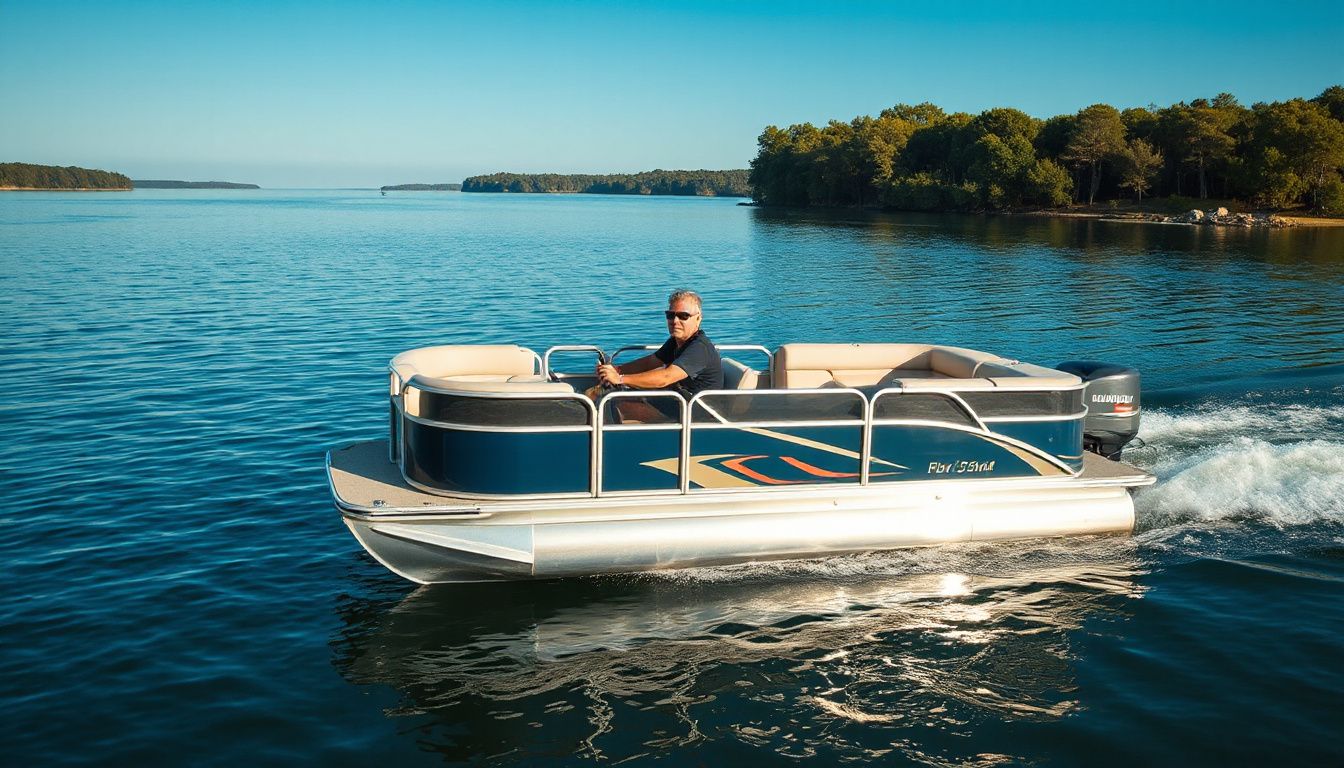
How to Drive a Pontoon Boat: Step-by-Step Docking & Handling
Learning how to drive a pontoon boat means mastering a different set of instincts than you'd use in a car or a traditional V-hull. Pontoons sit high on the water, have a large wind profile, and respond slowly to steering. They don't carve turns like a ski boat, and they get pushed sideways easily by wind and current. That doesn't make them hard to operate — it makes them predictable once you understand the physics.
This guide walks you through the complete process, from pre-departure checks to docking and shutdown. By the end, you'll have a repeatable system for handling a pontoon confidently, even in less-than-perfect conditions.
Before you start, it helps to be familiar with the boat itself. If you're still shopping, choosing the right pontoon for your water conditions is the first step to easier handling. A longer, heavier hull with a larger engine responds differently than a compact two-tube model, so match the boat to where you'll actually operate.
Here's what we'll cover:
- Pre-departure safety gear, rules, and boat inspection
- Starting the engine and setting controls correctly
- Low-speed maneuvering away from the dock
- Open-water speed and directional control
- Handling wind, current, and wakes
- Step-by-step docking and tying off
- Shutdown and post-trip checks
- Common mistakes and how to fix them
Let's get started.
Prepare Before You Start: Gear, Rules, and Boat Checks
Most docking mishaps and on-water stress come from skipping preparation. A few minutes before departure solves most of the problems you'd otherwise face at the dock.
Start with required safety equipment. In the United States, the Coast Guard sets minimum carriage requirements for recreational boats, and state rules often add more. Check official boating safety requirements before you launch so you're never caught short. In practice, the following should be on board every trip:
- Life jackets: One Coast Guard-approved PFD per person, properly sized, and worn by children and weak or non-swimmers at all times. Keep them accessible, not buried in a locker.
- Throwable flotation device: A ring buoy or cushion within arm's reach of the helm.
- Fire extinguisher: Charged, accessible, and rated for your boat's size.
- Sound-producing device: A whistle or horn that works, even if it's just a plastic pea whistle.
- Visual distress signals: Required on many waterways, especially coastal or large lakes.
- Dock lines and fenders: Rigged and ready before you leave the slip, with fenders at the correct height.
Next, confirm the rules and conditions for the day. Speed limits change by waterway, no-wake zones require you to idle, and alcohol laws on the water are often stricter than on land. Wind is the single biggest factor in how a pontoon handles near the dock, so check the marine forecast from NOAA before you leave the ramp or slip. If winds are gusting above 15 knots, docking becomes significantly harder — consider postponing or choosing a more protected launch.
Now perform a quick boat inspection. Confirm the fuel level, turn the battery switch to ON, check the bilge for water, and verify the drain plug is in if your boat has one. Walk around the boat and inspect the propeller area for weeds, fishing line, or damage. Test the navigation lights if you'll be out near dusk, and make sure the engine's kill switch lanyard is clipped to the helm.
A practical example: before a busy Saturday launch, stage two bow lines and a stern line, hang your fenders on the dock side, and assign one passenger to handle a midship line only after you give the word. Agree on simple hand signals or verbal cues like "line" and "clear." That small script reduces shouting and pinched fingers when everyone is moving in different directions. Good preparation is as much about communication as it is about gear.
Routine upkeep also reduces surprises. Keeping the hull and deck in good condition before each outing helps you spot loose hardware, soft spots, or damage that could affect handling.
Start the Engine and Set Up Controls for Safe Operation
Once prep is done, bring the boat to life in a controlled, repeatable sequence. The goal is a clean start, confirmation that steering and throttle respond normally, and a slow, predictable exit.
At the helm, run through this checklist before turning the key:
- Confirm the throttle is in neutral.
- Attach the kill-switch lanyard to your life jacket or wrist.
- If your engine has a blower and you've been fueling recently, run it for the recommended period before starting.
- Turn the battery switch to ON.
- Start the engine and watch the gauges: steady idle, normal oil pressure, and no warning alarms.
With the engine idling, test the steering. Turn the wheel slowly left, then right, and watch the outboard or drive respond smoothly through its full range. Confirm the gear indicator works, and practice the neutral pause between forward and reverse. Shifting directly from forward to reverse at speed is hard on the lower unit and can yank the boat unpredictably.
A common mistake is leaving the engine trimmed too high for low-speed work. Trim down for better steering authority near the dock, then adjust once you're clear of traffic and wake zones. When you do adjust trim in open water, make small changes and give the boat a few seconds to respond before adjusting again.
 The helm is your command center: confirm neutral throttle, lanyard attachment, and smooth steering before leaving the dock.
When you're ready to leave, use brief, deliberate throttle bumps rather than continuous power. Pontoon boats have a lot of windage — momentum builds quickly and takes considerable distance to stop. A one-second shift into gear, followed by a return to neutral, is often enough to get you moving while keeping speed low and control high.
Practical example: leaving a slip with wind pushing the bow off, keep the wheel straight, shift into reverse for one second to stop the drift, pause in neutral, then bump forward and steer out. It's calm, predictable, and keeps the stern from swinging into the dock.
Idle Away from the Dock and Practice Low-Speed Steering
Now it's time to leave the dock without drama. Keep the engine at idle, use short gear shifts, and let the boat's momentum do most of the work. A pontoon doesn't carve — it slides. Small, patient corrections work far better than aggressive steering.
Begin by checking your exit path. Confirm the area is clear of other boats, swimmers, and obstacles, then release lines in a controlled order. Have a crew member hold the boat with a line until you confirm the path is open. "Slow" is a safety tool at the dock, not a lack of skill.
At idle speed, practice steering with short, deliberate wheel inputs. You'll notice a delay between turning the wheel and the boat's actual response, especially in wind. Accept that delay and work with it rather than fighting it. Look for a steady heading, not a perfect straight line.
- Use bump shifts: Brief forward, back to neutral, then coast. This keeps speed low while preserving steering control.
- Turn early: Pontoons need room to swing the bow. Start turns before you think you need to.
- Keep hands light: Oversteering causes zig-zagging, which looks and feels uncontrolled.
In practice, many new operators stay in gear too long, building speed they can't bleed off quickly. If wind pushes the bow off, aim slightly into it and let the boat settle into the corrected heading rather than cranking the wheel back and forth.
Practical example: leaving a crowded marina slip, bump into forward for two seconds, return to neutral, and turn the wheel a quarter-turn toward open water. The boat glides out while a crew member steps off the dock only after the stern clears, preventing a risky dock push. Once clear, spend five minutes running slow circles and figure-eights in open water before heading out. This builds the muscle memory you'll need at the dock later.
Control Speed and Direction in Open Water
Once you're clear of traffic and shallow hazards, focus on smooth control. Bring the boat onto a steady heading, then increase throttle gradually until the boat feels planted. Speed changes affect steering response, stopping distance, and passenger comfort, so make adjustments deliberately.
Practice three core maneuvers:
- Straight tracking: Pick a distant landmark — a buoy, tree, or point — and hold it steady on the bow. This teaches you to make tiny corrections well before drifting off course.
- Wide turns: Start early and keep throttle steady through the arc. Sharp wheel cranks at speed can swing the stern unexpectedly and toss passengers.
- Controlled stops: Ease off the throttle to idle, shift to neutral, then use brief reverse if you need to stop shorter. Never slam into reverse at speed.
Trimming the engine makes a noticeable difference at cruising speed. Start with the engine trimmed down for launch, then trim up slightly once you're planing or at your preferred cruising speed to raise the bow and reduce drag. Each small trim change alters handling, so pause between adjustments. If the boat starts porpoising — bouncing bow-up and bow-down repeatedly — trim down a touch.
Speed management also depends on your boat's setup. A pontoon with two small tubes and a modest engine handles differently than a triple-tube performance model. If you're still learning your boat's manners, spend time experimenting in calm, open water away from other traffic. That's exactly why selecting a boat matched to your use case matters before you build new habits.
Practical example: in a calm bay, accelerate to a comfortable cruise, choose a buoy as a reference, and hold course for 200 yards. Then perform a gentle 180-degree turn at steady throttle, return to the original line, and practice a stop that leaves the boat settled rather than rocking passengers forward. Repeat until each input feels intentional.
Handle Wind, Current, and Wakes Without Losing Control
Wind and current act on a pontoon's big, flat profile far more than on a deep-V hull. The extra surface area above the waterline means even a light breeze can push you around. Plan corrections early instead of reacting late.
First, identify what's moving the boat by watching fixed references. If you drift sideways relative to a buoy or shoreline, that's set from wind or current. If the bow keeps getting pushed off line, you need to "crab" into the force to hold a straight track.
| Condition | What You Feel | Correct Technique |
|---|---|---|
| Headwind | Slower response, bow pushed slightly off | Add a small amount of throttle, steer 5–15° into the wind |
| Crosswind | Sideways drift, especially at idle | Aim the bow upwind, use short throttle bursts to keep steerage |
| Following sea/wake | Pushed sideways, bow wants to dig | Slow to displacement speed, meet wakes at 30–45° |
| Strong current | Hard to hold position, stern swings | Use slightly higher RPM for rudder authority, don't fight at idle |
Wakes deserve special attention because they can shove the stern sideways and swing the bow unexpectedly. Meet wakes at a 30–45 degree angle rather than straight on, and slow to a controlled speed before the wave reaches you. Keep a hand on the wheel, ease off throttle before the wake, then add power after the pontoons clear it.
A common mistake is turning sharply on top of a wake, which can cause a sudden slide — the hull catches, the stern swings, and you lose directional control for a second. Another mistake is charging into wakes at full speed with the bow high; that produces a hard slap and soaks passengers.
Practical example: crossing a busy channel, angle slightly into the crosswind, take a passing cruiser's wake at 40 degrees, and keep speed low enough that the bow doesn't slap. Gusty wind? Use short throttle bursts to regain steering, then return to idle. The forecast from NOAA's marine weather service will tell you whether wind is steady or gusty before you launch.
 Fenders deployed and lines staged: the setup for a controlled, low-drama docking approach.
Approach, Dock, and Secure the Pontoon Boat Step by Step
Docking is where all the earlier practice pays off. The key is a repeatable sequence: set up early, commit to a slow plan, and communicate clearly with your crew. A pontoon docks best when it's moving just fast enough to steer — typically a fast walking pace.
Choose Your Approach
- No wind or current: Approach at a shallow 10–20 degree angle, shift to neutral one boat-length out, and coast in.
- Wind pushing you toward the dock: Approach at a smaller angle, let the wind help set you against the dock, and use reverse to slow the final drift.
- Wind pushing you off the dock: Approach slightly faster and a touch steeper, then shift to neutral earlier so the wind "sets" you in. Be ready with a line.
- Current running along the dock: Approach against the current if possible, using just enough throttle to maintain steerage as the current carries you toward the dock.
Execute the Sequence
- Brief the crew before you enter the marina: who handles which line, who steps off first, and when.
- Set fenders at dock height on both sides if there's any uncertainty about which side you'll tie to.
- Line up your approach angle and reduce speed to idle.
- Shift to neutral and coast. Use brief forward or reverse bumps to control drift as needed.
- As the bow nears, straighten the wheel and let the boat settle alongside.
- Secure the bow line first, then the stern line. Add a spring line if you'll be docked for a while or in gusty conditions.
Nobody should jump from the boat to the dock. A crew member steps off only when the boat is stable and close enough to step, not leap. The operator's job is to hold the boat steady until that moment.
In practice, coming in hot is the most common docking mistake. Relying on reverse at the last second swings the stern wide and often ends with a hard hit. If you're unsure, go around and try again — there's no shame in a second approach, but there is damage from a rushed one.
Once the boat is alongside, tie off properly. Caring for the deck and carpet after a day of docking keeps the interior from wearing out prematurely, especially in high-traffic boarding areas.
Shut Down, Tie Off, and Complete Post-Trip Checks
The last five minutes at the dock are still part of driving safely. Keep the engine at idle, let passengers stay seated, and avoid abrupt shifts while lines are being handled. A calm shutdown prevents prop strikes, dock damage, and avoidable injuries.
Once the boat is secured, shift to neutral and let the engine idle for 30–60 seconds to cool down. Then turn off accessories, shut down the engine, and remove the key or lanyard. Watch for unusual alarms, smells, or steam before anyone steps off.
Tying off correctly controls both forward-and-back and side-to-side movement. Use a bow line, a stern line, and at least one spring line when conditions are gusty or you'll be docked overnight. A common mistake is tying a single bow line and walking away; wind will pivot the stern into the dock within minutes. Set your fenders at rub-rail height and re-check them after the boat settles with the load.
Post-trip, run through a quick checklist:
- Inspect the prop area visually for weeds or line — no hands near the prop, even with the engine off.
- Check the bilge and deck for water, trash, and loose gear.
- Log fuel level and any handling issues to address before the next outing.
- If you trailer the boat, flush the engine per manufacturer guidance after saltwater use.
For longer-term care, protecting an aluminum hull with the right paint prevents corrosion and keeps the boat easier to handle in the long run. A clean, well-maintained hull tracks better and resists the effects of wind and current more predictably.
Practical example: after docking on a breezy afternoon, run a midship spring line to stop the boat from creeping forward, then snug the stern line to keep the aft corner off the cleat. The boat stops "sailing" against the dock, and boarding stays stable.
Common Mistakes and How to Fix Them
Most handling problems on a pontoon come down to a handful of repeatable errors. Here's what goes wrong most often — and how to correct it.
| Mistake | What Happens | The Fix |
|---|---|---|
| Approaching the dock too fast | Hard impacts, panic stops, stern swing | Reduce speed earlier; neutral sooner; go around if unsure |
| Oversteering at low speed | Zig-zagging, loss of control | Use smaller wheel inputs; pause between corrections |
| Staying in gear too long | Built-up momentum, hard stops | Bump shifts: one second in gear, then coast |
| Turning sharply at speed | Stern swings wide, passengers thrown | Start turns early; keep throttle steady through the arc |
| Fighting wind with the wheel | Feverish corrections, drift worsens | Aim into wind, accept a slight angle, use throttle bursts |
| Tying off with one line | Stern pivots into dock | Bow, stern, and spring lines always |
| Shifting from forward to reverse instantly | Lower unit strain, unpredictable movement | Pause in neutral between gears |
In practice, the fix for almost every mistake is the same: slow down sooner and make smaller inputs. A pontoon rewards patience more than any other boat type. When you feel yourself rushing, take a breath, shift to neutral, and reassess.
Frequently Asked Questions
Do I need a boating license to drive a pontoon boat?
It depends on your state. Many states require a boater education card or license for operators above a certain age, especially on public waterways. Check your state's boating agency requirements before launching. Even where not required, taking a safety course is strongly recommended and often reduces insurance costs.
What is the top speed of a pontoon boat?
Most two-tube pontoons with a 90–150 horsepower engine cruise at 20–28 mph, while triple-tube performance models with larger engines can exceed 40 mph. Your boat's speed depends on tube size, engine power, load, and water conditions. Heavier loads and rough water reduce top speed significantly.
Can a pontoon boat sink?
Rarely, but possible. Pontoon tubes are sealed compartments, but if a tube gets punctured or a drain plug fails, water can enter. Uneven flooding can cause instability. Most pontoons remain afloat with one damaged tube, but always inspect tubes before launch and carry a pump for the bilge.
How hard is it to dock a pontoon boat in wind?
Wind makes docking more challenging, especially crosswinds above 10–15 knots. The key is planning your approach to work with the wind, not against it. Aim the bow into the wind, use short throttle bursts to maintain steerage, and don't be afraid to use extra fenders and a spring line.
Do I need to winterize my pontoon boat?
Yes, if you store it in freezing temperatures. Drain the engine block and lower unit, add fuel stabilizer, fog the cylinders, and protect the interior from moisture. Failing to winterize can crack the engine block. Consult your engine manufacturer's checklist before winter storage.
What safety gear is required on a pontoon boat?
At minimum, you need a PFD for every passenger, a throwable device, a fire extinguisher, a sound-producing device, and visual distress signals on many waterways. State and local rules may add requirements. Always carry more than the minimum — it's cheap insurance.
Conclusion
Driving a pontoon boat is less about raw skill and more about building a repeatable, deliberate system. Prepare thoroughly before you leave, use smooth and patient inputs at the helm, read the wind and current early, and approach every dock with a plan and a backup plan. Most mistakes come from rushing, and most fixes come from slowing down.
Your next step is simple: take this guide on your next outing and run through the sequence one step at a time. Practice low-speed maneuvers in open water first, then work on docking in calm conditions before testing yourself in wind. With just a few focused sessions, the motions become automatic.
Eventually, you may find yourself pushing the limits of your current boat and wondering if a different hull would handle better. When that day comes, knowing how to part with an old boat responsibly is the final part of the ownership journey. Until then, stay slow, stay sharp, and enjoy the water.